
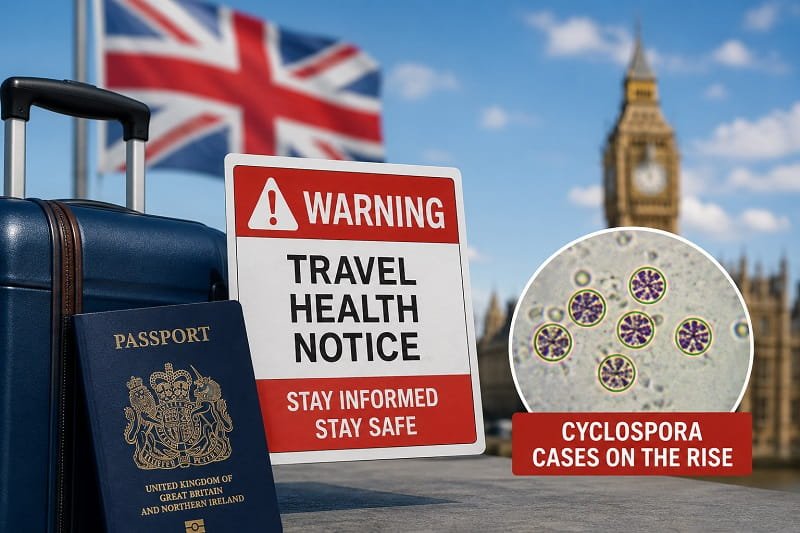
UK Issues Travel Health Warning After Spike in Cyclospora Cases

Public health authorities in the United Kingdom issued an urgent epidemiological warning following a sharp, seasonal surge in cyclosporiasis rise uk travelers returning from popular holiday destinations in Mexico. According to official surveillance data published on July 30, 2026, by the UK Health Security Agency, laboratory testing confirmed dozens of imported gastrointestinal parasite infections between late spring and mid-summer. Health officials confirmed that the majority of affected holidaymakers had recently stayed at all-inclusive luxury resorts along Mexico’s Caribbean coastline, prompting coordinated cross-border investigations into food supply chains and agricultural hygiene standards across North America.
The official epidemiological bulletin released by the UK Health Security Agency on July 30, 2026, documented a total of 67 laboratory-confirmed cases of cyclosporiasis across England, Scotland, and Wales between April 30 and July 15, 2026. Surveillance figures show that England recorded 30 cases, Scotland reported 27, and Wales registered 10. The geographic distribution of the cases demonstrates a pronounced nationwide spike compared to historical baselines, with public health experts noting that total reported cases within the ten-week period already approach the historical multi-year annual average of 93 cases recorded between 2022 and 2025.
Detailed travel history obtained from 52 of the confirmed patients revealed that 48 individuals had returned directly from Mexico prior to falling ill, including one traveler who had visited both Mexico and the United States. Of those who provided granular resort-level itineraries, primary clusters were identified in the Riviera Maya region and the resort city of Cancún. Affected travelers reported staying across various independent and chain resort properties, consuming diverse menu items as part of package holidays. Public health epidemiologists emphasized that the distribution of cases across multiple independent hotel chains points toward broader regional contamination of fresh agricultural produce rather than isolated food handling failures at single hotel kitchens.
Dr. Philip Veal, Consultant in Travel Health at the UK Health Security Agency, formally issued guidance on July 30, 2026, urging British holidaymakers to exercise extreme vigilance when dining abroad. “We have recently detected a rise in Cyclospora infections among travellers returning from Mexico,” said Dr. Philip Veal, Consultant in Travel Health at the UK Health Security Agency. “These infections are caused by a parasite and can affect the stomach and intestines. Travellers to Mexico and other areas where the infection is more common can reduce their risk by following good food and water hygiene measures, including drinking bottled water and eating thoroughly cooked food, even when staying in high-end all-inclusive resorts.”
Understanding Cyclospora: Clinical Characteristics and Parasitic Transmission
Cyclosporiasis is a intestinal infection caused by the microscopic single-celled protozoan parasite Cyclospora cayetanensis. The parasite is endemic to tropical and subtropical regions worldwide, including Central America, South America, South Asia, Southeast Asia, the Middle East, and parts of Africa. Medical authorities emphasize that Cyclospora cayetanensis does not naturally occur within the United Kingdom’s temperate climate, meaning every domestic diagnosis stems directly from international travel or imported contaminated produce. Unlike bacterial pathogens that multiply rapidly at ambient temperatures, the parasite requires specific environmental conditions to mature into an infectious stage after excretion.
Transmission occurs exclusively through the fecal-oral route when individuals consume food or water contaminated with human feces containing immature oocysts. When an infected individual excretes Cyclospora oocysts in their stool, the organisms are unsporulated and non-infectious to others. The oocysts require days to weeks in ambient environmental conditions—typically in warm, moist soil or fresh agricultural irrigation water—to undergo sporulation and become capable of causing infection. Consequently, direct person-to-person transmission is impossible, distinguishing cyclosporiasis from highly contagious viral pathogens such as norovirus or bacterial strains like Shigella.
According to clinical guidance published by Public Health Scotland on July 30, 2026, the incubation period for cyclosporiasis averages seven days, though symptoms can manifest anywhere between two and fourteen days following the ingestion of sporulated oocysts. The disease primarily targets the mucosal lining of the small intestine, triggering symptoms that vary from mild intestinal distress to severe, debilitating gastrointestinal illness. The hallmark clinical symptom is frequent, watery, and sometimes explosive diarrhea. Accompanying symptoms routinely include severe abdominal cramping, pronounced bloating, increased flatulence, nausea, fatigue, low-grade fever, anorexia, and substantial unintended weight loss.
Dr. Dipti Patel, Director of the National Travel Health Network and Centre, highlighted the distinct clinical presentation of the parasite during a medical advisory statement on July 30, 2026. “Cyclospora infections can be remarkably persistent if left untreated, often following a relapsing-remitting pattern that lasts for weeks or even months,” stated Dr. Dipti Patel, Director at the National Travel Health Network and Centre. “While most healthy individuals eventually recover, the prolonged nature of the illness causes significant exhaustion and dehydration. Anyone returning from abroad with lingering gastrointestinal symptoms must inform their GP of their travel history so specific diagnostic stool tests can be ordered.”
Epidemiology and Historical Trends Across the United Kingdom
The 2026 seasonal surge represents a continuation of recurrent travel-associated outbreaks that have challenged public health agencies in Western Europe for over a decade. Surveillance records maintained by the UK Health Security Agency show that imported cyclosporiasis cases in the United Kingdom typically exhibit a sharp seasonal peak between May and August, coinciding with the peak summer holiday travel season to Central America and the Caribbean. Historical data published in the UKHSA Health Protection Report indicates that England recorded 87 total cases of cyclosporiasis in 2025, following 124 cases in 2024 and 47 cases in 2023, reflecting fluctuating travel volumes and varying agricultural contamination levels in source countries.
Demographic breakdowns of the 67 confirmed cases from the May-July 2026 cohort reveal specific patient patterns across the UK. According to official UKHSA statistics, age data was available for all 67 patients, establishing a overall median patient age of 46 years. Among the 59 patients where biological sex was recorded, 66 percent were female. Epidemiologists note that these demographics closely mirror typical passenger profiles for UK tour operators offering all-inclusive resort packages in the Riviera Maya region during early summer. The high proportion of Scottish cases relative to population—27 of the 67 total UK cases—prompted Public Health Scotland to issue localized alerts to Scottish general practitioners and travel clinics.
Dr. Nick Phin, Director of Public Health Science at Public Health Scotland, addressed the regional distribution of cases in an official health advisory on July 30, 2026. “The cluster of cases identified in Scotland underscores the importance of pre-travel health consultation and vigilant food safety awareness,” said Dr. Nick Phin, Director of Public Health Science at Public Health Scotland. “Our surveillance systems detected a notable proportion of returning travelers presenting with symptoms consistent with parasitic infection. Because standard bacterial stool cultures do not automatically test for protozoan parasites like Cyclospora, clinicians must explicitly request PCR or specialized microscopy testing for patients presenting with post-travel diarrhea.”
The geographical scope of the current outbreak extends beyond the borders of the United Kingdom, reflecting broader international agricultural supply dynamics. In concurrent epidemiological bulletins published in July 2026, the United States Centers for Disease Control and Prevention documented a widespread multi-state cyclosporiasis outbreak affecting thousands of citizens across 45 US states. Federal health authorities in the United States linked a major cluster of domestic cases to imported fresh produce, specifically identifying contaminated shredded iceberg lettuce originating from central Mexican agricultural regions as a primary transmission vector during the summer of 2026.
Fresh Produce as the Primary Transmission Vector
Public health investigators consistently identify fresh, uncooked produce as the chief delivery mechanism for Cyclospora parasites. Agronomic studies demonstrate that delicate fruits, fresh culinary herbs, and leafy greens possess textured surfaces that allow microscopic oocysts to adhere tightly. Water used for agricultural irrigation, pesticide mixing, or crop washing that has been contaminated with untreated human sewage serves as the primary contamination point on farms. Once oocysts attach to the outer leaves of lettuce, the surface folds of raspberries, or the fine leaves of fresh cilantro, standard washing with plain water is frequently insufficient to dislodge the sticky parasite walls.
Specific agricultural commodities have been repeatedly implicated in historic and active international outbreaks. Epidemiological studies conducted by the World Health Organization identify fresh berries—particularly raspberries and blackberries—alongside soft herbs such as basil, mint, and cilantro, as well as pre-packaged salad leaves, snow peas, and raw peppers as high-risk foods. In all-inclusive resort settings, high-volume buffet stations featuring cold raw salad bars, fresh fruit platters, garnishes, and blended fruit smoothies present elevated exposure risks for international guests who consume raw items without further thermal processing or peeling.
Professor Sarah O’Brien, Professor of Infection Epidemiology and Child Health at the University of Liverpool, explained the complex food safety challenges surrounding fresh produce imports and resort catering in an academic analysis published in July 2026. “Microscopic parasites like Cyclospora present unique challenges to global food safety systems because traditional chemical sanitizers and chlorine washes used in commercial packaging plants do not reliably destroy the tough outer shell of the oocyst,” explained Professor Sarah O’Brien, Professor of Infection Epidemiology at the University of Liverpool. “Because these delicate crops are eaten raw, boiling or thorough cooking is the only absolute method to eliminate infection risk, which runs directly counter to typical consumer dining expectations at tropical holiday resorts.”
Environmental factors in agricultural producing zones play a decisive role in seasonal outbreak intensity. Heavy rainfall events and flooding in subtropical agricultural basins can cause primitive sewage infrastructure to overflow into rivers, canals, and ground wells used for agricultural irrigation. When contaminated water is sprayed onto growing crops shortly before harvest, microscopic oocysts adhere to the produce and survive the cold-chain shipping process to domestic markets or local resort kitchens. Furthermore, the persistent nature of sporulated oocysts allows them to remain viable in moist environments for extended periods, compounding food safety risks across complex supply chains.
International Coordination and Industry Response
In response to the rising case counts among British holidaymakers, UK health authorities initiated formal cross-border communication protocols with international partners and commercial travel organizations. The UK Health Security Agency confirmed on July 30, 2026, that it is actively collaborating with ABTA—the Association of British Travel Agents—and Mexican public health authorities to investigate supply chain vulnerabilities and reinforce health standards across affected resort regions. ABTA has disseminated updated health warnings to tour operators, travel agencies, and resort management teams operating in Cancún, Cozumel, and the Riviera Maya.
A spokesperson for ABTA issued a formal statement on July 30, 2026, detailing the industry’s preventive posture regarding guest health and safety. “We work closely with the UK Health Security Agency, foreign government authorities, and our travel operator members to ensure strict health and hygiene guidelines are maintained across destination resorts,” stated a spokesperson for ABTA. “Travelers heading to tropical destinations are strongly advised to consult official travel health portals prior to departure and adhere rigorously to recommended food and water precautions throughout their stay.”
Mexican tourism and health ministries have historically implemented enhanced sanitation inspections and agricultural testing protocols in response to joint UK-US health warnings. In major resort zones across Quintana Roo, public health inspectors enforce strict sanitation codes for resort water treatment plants, ice machines, and commercial food preparation areas. However, because the primary contamination source frequently originates in rural farming districts hundreds of miles away from coastal resort hotels, localized kitchen hygiene alone cannot entirely eliminate the parasite from incoming shipments of fresh produce and herbs.
In parallel, the National Travel Health Network and Centre updated its TravelHealthPro portal on July 30, 2026, publishing comprehensive destination-specific advisory notices for citizens traveling to Mexico, Central America, and the Caribbean. The specialized travel medicine agency emphasized that travelers must maintain rigorous hygiene standards regardless of the star rating or price point of their accommodation, noting that high-end all-inclusive luxury resorts receive fresh produce from the same regional agricultural supply networks as budget hotels and local markets.
Clinical Diagnosis, Treatment, and Medical Management
Diagnosing cyclosporiasis requires specific laboratory methodologies because standard clinical examinations cannot distinguish Cyclospora from other parasitic, bacterial, or viral causes of gastroenteritis. When a patient presents with persistent watery diarrhea following international travel, medical guidelines instruct clinicians to request specialized stool testing. Molecular diagnostics using real-time polymerase chain reaction assays have largely superseded traditional stool microscopy, allowing clinical laboratories to rapidly detect Cyclospora cayetanensis DNA with exceptional sensitivity and specificity within hours of sample collection.
While cyclosporiasis is generally self-limiting in healthy adults with intact immune systems, the natural duration of symptoms can extend from several weeks to over a month without medical intervention. The relapsing nature of the infection frequently leads patients to believe they have recovered, only for severe watery diarrhea, abdominal cramping, and profound exhaustion to recur days later. For immunocompromised individuals, including patients living with HIV, cancer patients undergoing chemotherapy, or individuals taking immunosuppressive biological therapies, the parasite can cause protracted, life-threatening diarrhea leading to severe malabsorption, significant electrolyte imbalances, and extreme weight loss.
According to clinical treatment guidelines published by the National Health Service, the definitive pharmacological treatment for confirmed cyclosporiasis is a targeted course of oral antibiotics. The primary drug of choice is trimethoprim-sulfamethoxazole, commercially known as co-trimoxazole. A standard treatment regimen for adult patients typically consists of one double-strength tablet administered twice daily for seven to ten days. For patients with documented severe allergies to sulfa medications, alternative therapeutic options are limited, as standard antiprotozoal drugs such as metronidazole or tinidazole are ineffective against Cyclospora; in such cases, ciprofloxacin or nitazoxanide may be prescribed under specialized infectious disease consultation.
Dr. Gemma Harris, Consultant Microbiologist at the Royal Free London NHS Foundation Trust, emphasized the importance of proper medical evaluation for returning travelers in a clinical advisory issued in July 2026. “Patients presenting with persistent post-travel gastrointestinal distress should never rely solely on over-the-counter anti-motility medications like loperamide,” stated Dr. Gemma Harris, Consultant Microbiologist at Royal Free London NHS Foundation Trust. “Antidiarrheal agents can trap the parasite and its toxins within the intestinal tract, potentially exacerbating symptoms. Obtaining a clear diagnostic stool sample and administering targeted co-trimoxazole therapy remains the gold standard for rapidly resolving the infection and preventing chronic nutritional depletion.”
Prevention Strategies for International Travelers
Because no preventive vaccine or prophylactic medication exists to protect against Cyclospora infection, medical experts unanimously stress that personal food and water hygiene represents the sole defense for international travelers. Public health guidance issued by NaTHNaC advises holidaymakers traveling to endemic regions to strictly adhere to the traditional travel medicine rule of thumb: cook it, peel it, boil it, or forget it. Travelers are cautioned to maintain these protective behaviors consistently across all dining settings, including high-end resort buffets, cruise ships, fine dining establishments, and street food vendors.
Water hygiene forms a fundamental pillar of parasite prevention. Travelers should consume only commercially sealed bottled water or tap water that has been brought to a rolling boil for at least one minute. This precaution extends to routine daily activities, including tooth brushing and rinsing contact lens cases. Ice cubes present a frequent hazard in resort environments; travelers should explicitly request drinks without ice unless they can independently verify that the ice was produced using purified, filtered, or boiled water. Chemical disinfection tablets containing chlorine or iodine are generally less effective against protozoan oocysts than thermal boiling or absolute sub-micron filtration.
Dietary modifications require conscious selection when navigating resort buffets and restaurants. Public health agencies strongly advise travelers in high-risk destinations to avoid consuming raw salads, unpeeled fresh fruits, raw berries, unpasteurized dairy products, and fresh herb garnishes such as raw basil, mint, or coriander. Instead, holidaymakers should choose hot, freshly cooked meals served steaming, alongside fruits with thick, intact skins—such as bananas, oranges, and pineapples—that can be personally peeled immediately prior to consumption. Cooked vegetables, pasteurized dairy products, and commercially processed packaged foods represent significantly safer dietary choices.
Personal hand hygiene, while essential for preventing bacterial and viral illness, plays a secondary role in preventing Cyclospora due to the parasite’s inability to spread directly from person to person. However, frequent handwashing with clean water and soap remains highly recommended before eating or preparing food. Alcohol-based hand sanitizers, while effective against many common pathogens, do not reliably destroy protozoan oocysts or bacterial spores, making proper handwashing with running water and soap the superior hygiene choice whenever feasible.
Long-Term Outlook and Public Health Guidance
Public health authorities anticipate that reported cases of cyclosporiasis among UK holidaymakers will continue to accumulate throughout the remainder of the summer holiday season. As travel volumes between the United Kingdom, Mexico, and the United States remain elevated through August and early September 2026, epidemiologists at the UK Health Security Agency are maintaining heightened national surveillance. General practitioners and emergency departments across Britain have been alerted to maintain a high index of suspicion for returning travelers exhibiting persistent gastrointestinal symptoms.
The convergence of the UK imported case surge with the massive, multi-state outbreak reported by the US Centers for Disease Control and Prevention highlights systemic vulnerabilities in modern international food distribution and agricultural sanitation. As agricultural supply chains become increasingly globalized, parasitic pathogens previously restricted to specific geographic regions are routinely transported across international borders, affecting both domestic consumers in importing nations and international tourists visiting producing regions. Environmental changes, extreme weather events, and shifting agricultural irrigation practices are expected to continue influencing the frequency and magnitude of seasonal parasite outbreaks in the coming years.
Medical researchers and public health organizations are calling for enhanced international cooperation to address the root causes of agricultural parasite contamination. Proposals include expanding technical assistance to farming communities in developing export markets, implementing advanced water filtration systems for agricultural irrigation, and deploying rapid, DNA-based field testing kits to detect parasite contamination prior to harvest. Until comprehensive agricultural sanitation interventions can be fully integrated across international farming basins, consumer awareness and strict personal dietary precautions will remain the paramount line of defense against travel-associated cyclosporiasis.
In summary, the sharp rise in cyclosporiasis rise uk travelers highlights a persistent, seasonally recurring public health challenge linked to international summer travel. With 67 confirmed cases documented by the UK Health Security Agency between April 30 and July 15, 2026—the vast majority connected to all-inclusive resorts in Mexico’s Riviera Maya and Cancún regions—health officials urge all citizens traveling abroad to practice rigorous food and water precautions. By avoiding raw salads, fresh berries, unpeeled fruits, and unboiled tap water, holidaymakers can dramatically lower their exposure risk.
For returning travelers who experience persistent watery diarrhea, abdominal cramps, fatigue, bloating, or unintended weight loss, seeking prompt medical evaluation is vital. Informing healthcare providers of specific travel itineraries enables accurate diagnostic stool testing and the timely administration of effective co-trimoxazole antibiotic therapy. Through continued epidemiological tracking, cross-border agency collaboration, and targeted traveler education, public health authorities aim to mitigate the impact of imported parasitic infections and protect the health of international holidaymakers.
Frequently Asked Questions Regarding Cyclospora and Travel Health
What is Cyclospora and how do travelers contract the parasite?
Cyclospora is a microscopic, single-celled protozoan parasite known scientifically as Cyclospora cayetanensis. Travelers contract the infection by ingesting food or water that has been contaminated with human feces containing the mature parasite oocysts. Common sources of infection include unwashed or raw fresh produce, such as salad leaves, fresh herbs like basil and cilantro, soft berries, and untreated drinking water or ice. The parasite is endemic in tropical and subtropical regions of Central America, South America, Asia, and Africa.
Can Cyclospora spread directly from person to person?
No, Cyclospora cannot be transmitted directly from one person to another. When the parasite oocysts are passed in human stool, they are immature and non-infectious. The oocysts require several days to weeks in environmental conditions outside the human body—typically in soil or water—to mature and sporulate into an infectious state. Consequently, casual contact, nursing an ill family member, or working alongside an infected individual poses no risk of direct person-to-person disease transmission.
What are the primary symptoms of a Cyclospora infection?
The primary symptom of cyclosporiasis is sudden, frequent, and watery diarrhea. Additional common symptoms include severe stomach cramps, abdominal pain, intense bloating, increased flatulence, nausea, loss of appetite, low-grade fever, muscle aches, fatigue, and noticeable weight loss. Symptoms usually appear about one week after consuming contaminated food or water. If untreated, the illness can follow a relapsing course lasting several weeks or even months.
How is a Cyclospora infection diagnosed and treated by doctors?
Cyclosporiasis is diagnosed through specialized laboratory analysis of stool samples, most commonly using sensitive polymerase chain reaction DNA assays or specialized microscopic examinations. Standard bacterial stool cultures will not detect the parasite, so patients must inform their doctor of their specific travel history. The standard medical treatment for confirmed cases is a seven- to ten-day course of the oral antibiotic trimethoprim-sulfamethoxazole, commonly known as co-trimoxazole. Most healthy patients experience rapid symptom relief once appropriate antibiotic therapy is initiated.
How can holidaymakers protect themselves when staying at all-inclusive resorts?
Holidaymakers can protect themselves by adhering strictly to safe food and water practices, regardless of the star rating or quality of their resort. Travelers should drink only bottled or boiled water, avoid ice cubes in beverages, and use bottled water when brushing their teeth. Dietary precautions include avoiding raw salads, unpeeled fruits, fresh berries, and raw herb garnishes. Opt instead for steaming hot, thoroughly cooked meals and fruits that you can peel yourself, such as bananas and oranges.