Travis Hunter: Heisman Winner and NFL Two-Way Star Redefining Football
Travis Hunter has emerged as one of the most revolutionary players in modern football history, captivating fans and reshaping how the sport views versatility. From his shocking commitment to Jackson State University under legendary coach Deion Sanders to winning the prestigious Heisman Trophy at the University of Colorado, Hunter’s journey represents a paradigm shift in college football. His selection as the second overall pick in the 2025 NFL Draft by the Jacksonville Jaguars has further solidified his status as a generational talent capable of excelling at both wide receiver and cornerback at the highest level of professional football.
Standing at six feet one inch tall and weighing 185 pounds, Hunter possesses a rare combination of athleticism, football intelligence, and competitive drive that distinguishes him from virtually every player in the modern era. His ability to dominate on both sides of the ball has drawn comparisons to NFL Hall of Famers like Deion Sanders and Charles Woodson, though Hunter’s two-way workload surpasses even these legendary figures. Throughout his college career, Hunter demonstrated unprecedented stamina by playing over 2,600 snaps across two seasons at Colorado, leading the entire Football Bowl Subdivision in total snaps during both the 2023 and 2024 seasons.
The Historic Jackson State Decision That Changed College Football
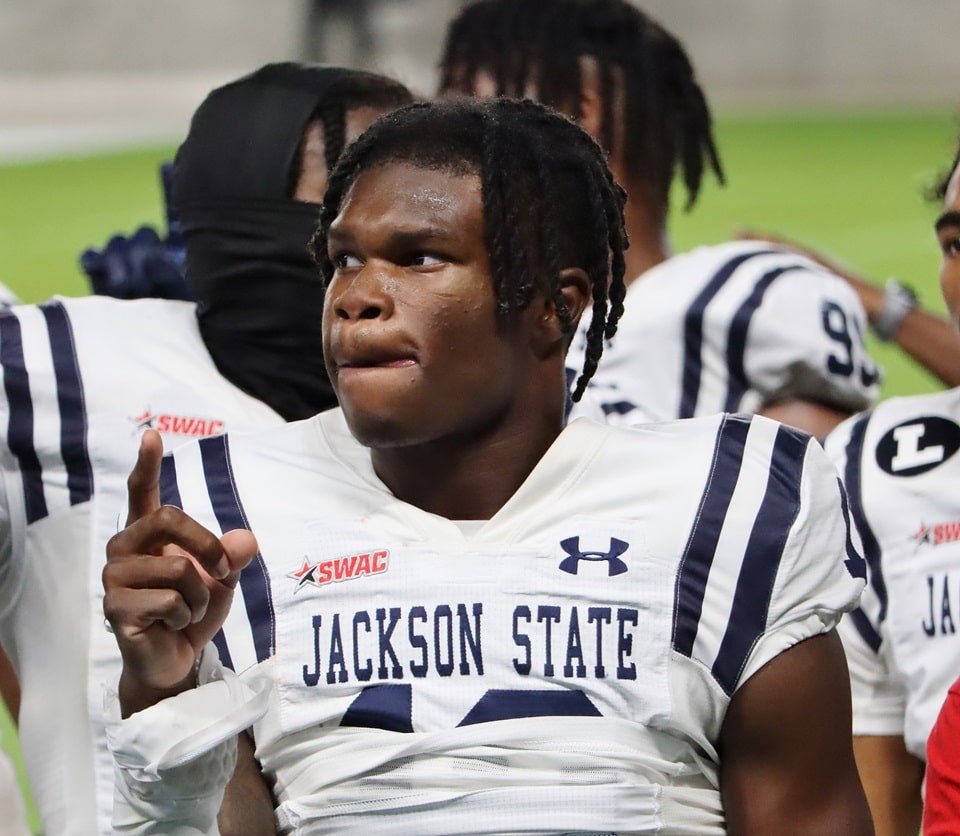
On December 15, 2021, Travis Hunter sent shockwaves through the college football world by flipping his commitment from Florida State to Jackson State University, an FCS program and historically Black college coached by Deion Sanders. As the number one overall prospect in the 2022 recruiting class according to 247Sports and Rivals, Hunter became the first five-star recruit to sign with an HBCU or FCS school in the modern recruiting era. This decision represented one of the most stunning moments in college football recruiting history, as elite prospects of Hunter’s caliber traditionally choose Power Five programs with greater resources, national television exposure, and direct pathways to NFL success.
Hunter had been committed to Florida State since March 2020, following an initial campus visit to the Seminoles. He maintained that commitment for over a year and a half despite FSU’s struggles under head coach Mike Norvell. However, after visiting Jackson State in November 2021 to watch the Tigers defeat Alcorn State in front of a sellout crowd, Hunter began seriously considering the HBCU program. Sanders, who starred at Florida State before his Hall of Fame NFL career, made a compelling pitch to Hunter that centered on playing time at both cornerback and wide receiver, something most Power Five coaches were hesitant to promise.
In his announcement statement, Hunter acknowledged the difficulty of turning away from his Florida State dream but emphasized his desire to contribute to HBCU football’s rich history and future. He referenced legendary HBCU players like Walter Payton, Jerry Rice, and Doug Williams as inspirations for his decision. Hunter stated his goal was to light the way for other elite prospects to recognize that HBCUs could provide everything they wanted and more. This decision immediately elevated national attention toward Jackson State and HBCU football programs, demonstrating that these institutions could compete for top-tier talent when the right circumstances aligned.
Jackson State Performance and Early Development
Hunter’s freshman season at Jackson State in 2022 showed flashes of his immense potential despite being limited by injuries. He sustained an undisclosed injury in his collegiate debut against Florida A&M that sidelined him for five games. When healthy, Hunter made his mark on both sides of the ball, recording two receiving touchdowns and two interceptions in Jackson State’s spring game, which became the first HBCU spring game to receive national television coverage. His presence helped generate unprecedented attention for the program, with attendance figures soaring and the football program creating a thirty million dollar economic impact on the city of Jackson, Mississippi.
By the end of his freshman year, Hunter had accumulated 19 total tackles, eight pass breakups, two interceptions, one fumble recovery, and one defensive touchdown in just seven games played. On offense, he added 18 receptions for 188 yards and four touchdowns. These numbers, while modest compared to his later accomplishments, demonstrated his ability to contribute immediately at both positions despite the physical demands of two-way play. Hunter also recorded his first collegiate touchdown and first interception in the same game against Alabama A&M, foreshadowing the dual-threat dominance he would display at higher levels of competition.
Following Sanders to Colorado after just one season at Jackson State, Hunter’s development accelerated dramatically. The move from FCS to FBS competition level presented new challenges, but it also provided a larger stage for Hunter to showcase his exceptional abilities. Sanders’ willingness to utilize Hunter extensively on both offense and defense proved crucial to his development, as most coaches would have limited his snaps to preserve energy and reduce injury risk. Instead, Sanders trusted Hunter’s conditioning and competitive spirit, allowing him to play nearly every snap in multiple games.
Colorado Breakthrough and National Recognition
Travis Hunter’s arrival at the University of Colorado in 2023 coincided with Deion Sanders taking over the Buffaloes program, creating immediate national intrigue. In his FBS debut against TCU, Hunter played 147 total snaps across offense and defense, recording 11 receptions for 119 yards while adding three tackles and an interception on defense. This performance in Colorado’s upset victory over the Horned Frogs announced Hunter’s arrival on the national stage and validated Sanders’ belief that he could handle the workload at the highest levels of college football.
Despite missing three and a half games due to a lacerated liver caused by a late hit during the 2023 season, Hunter still managed to make a significant impact. He finished the year with 57 receptions for 721 yards and five touchdowns on offense, while recording 30 tackles and three interceptions on defense. His performance earned him consensus All-America selection as an all-purpose player and the Paul Hornung Award, given annually to the most versatile player in college football. These achievements in a shortened season hinted at the extraordinary production Hunter would deliver when healthy for an entire campaign.
The Historic 2024 Heisman Season
The 2024 season witnessed Travis Hunter reach unprecedented heights, establishing himself as the most dominant two-way player in modern college football history. Hunter played 1,483 snaps, participating in 86.8 percent of Colorado’s offensive snaps and 82.9 percent of defensive snaps. This workload was 382 more scrimmage snaps than any other player in the country, demonstrating extraordinary conditioning and mental toughness. On offense, Hunter caught 92 passes for 1,152 yards and 14 touchdowns while rushing for one additional score. On defense, he recorded 31 tackles, 11 pass breakups, four interceptions, and 15 passes defended, which tied for fifth nationally.
Hunter’s statistical achievements placed him among the elite at both positions. He led the Big 12 Conference in receptions and receiving touchdowns while ranking second in receiving yards. Nationally, he finished second in receiving touchdowns, fifth in receptions per game at 7.7, and sixth in receiving yards per game at 96.0. Hunter led all of college football with 21 receiving plays of 20 yards or more, showcasing his big-play ability. Pro Football Focus graded him at 89.7 for receivers, the best mark in the Power Four conferences among players with 500-plus snaps. On defense, PFF rated him as one of only two defensive players to grade over 90 percent in coverage at the Power Four level.
The statistical dominance translated into historic award recognition. Hunter became the first player in college football history to win both the Chuck Bednarik Award as the nation’s top defensive player and the Fred Biletnikoff Award as the nation’s best wide receiver. He also claimed the Walter Camp Player of the Year Award, the Paul Hornung Award for versatility, the Lott IMPACT Trophy for defensive excellence, and Associated Press College Football Player of the Year honors. Hunter earned first-team All-Big 12 honors at both defensive back and wide receiver, becoming the first player in conference history to achieve this distinction.
Heisman Trophy Victory
On December 14, 2024, Travis Hunter was announced as the 90th winner of the Heisman Memorial Trophy during a ceremony at Jazz at Lincoln Center in New York City. Hunter received 552 first-place votes and 2,231 total points, capturing 80.14 percent of possible points, which ranks as the 11th highest percentage in Heisman Trophy history. Boise State running back Ashton Jeanty finished second with 309 first-place votes and 2,017 points, while Oregon quarterback Dillon Gabriel placed third with 516 points and Miami quarterback Cam Ward finished fourth with 229 points.
Hunter became only the second full-time defensive player to win the Heisman Trophy, joining Michigan cornerback Charles Woodson who won the award in 1997. However, Hunter distinguished himself as the first full-time two-way player to win the Heisman since the early 1960s and the first to win while playing significant minutes on both offense and defense since Woodson. He also became Colorado’s second Heisman winner, joining running back Rashaan Salaam who won the trophy in 1994, exactly 30 years earlier. Hunter is additionally the fifth player to win the Heisman as a full-time receiver and the first Heisman winner to begin his career in the Football Championship Subdivision.
During his emotional acceptance speech, Hunter expressed disbelief at achieving such recognition, stating he never imagined himself in that position. He gave special recognition to his hometown of Suwanee, Georgia, and credited Coach Prime for believing in his ability to excel at both positions when other programs expressed doubt. Hunter’s victory represented a triumph not only for individual excellence but also for players who refuse to be limited by conventional wisdom about specialization in modern football. His win validated the notion that exceptional athletes with proper conditioning and mental preparation can still dominate at multiple positions in contemporary college football.
NFL Draft and Jacksonville Jaguars Selection
Following his historic 2024 season, Travis Hunter declared for the 2025 NFL Draft as expected. The Jacksonville Jaguars, under new leadership with first-year general manager James Gladstone and head coach Liam Coen, identified Hunter as a franchise-altering talent worth aggressive pursuit. On April 24, 2025, the Jaguars executed a significant trade with the Cleveland Browns, moving up from the fifth overall pick to the second overall selection. Jacksonville sent the Browns the fifth overall pick, the 36th pick in the second round, the 126th pick in the fourth round, and their 2026 first-round selection. In return, the Jaguars received the second overall pick, the 104th pick in the fourth round, and the 200th pick in the sixth round.
With the second overall selection, the Jaguars drafted Travis Hunter, making him the highest-drafted cornerback in NFL history and tied for the second-highest drafted wide receiver alongside Calvin Johnson, who was also selected second overall by the Detroit Lions in 2007. Only Keyshawn Johnson, selected first overall by the New York Jets in 1996, has been drafted higher as a wide receiver. Hunter matched the highest draft position in Colorado football history, equaling Bo Matthews who was selected second overall by the San Diego Chargers in 1974.
Contract and Early Professional Career
The Jacksonville Jaguars signed Travis Hunter to a four-year rookie contract worth $46,649,114 with a $30,566,628 signing bonus. Hunter became the 30th first-round pick from the 2025 draft class to officially sign his deal. General Manager James Gladstone described Hunter as having the capacity to alter the trajectory of the sport itself, emphasizing the organization’s belief that he represents a unicorn talent who could immediately upgrade both the Jacksonville offense and defense.
Hunter began his NFL career focusing on offensive development during rookie minicamp, with defensive integration planned for subsequent weeks. Head Coach Liam Coen explained this strategic approach allowed Hunter to refine offensive concepts before adding the mental load of defensive responsibilities. The coaching staff implemented gradual exposure to both sides of the ball while monitoring his workload carefully, recognizing the unprecedented nature of attempting true two-way play in the modern NFL.
In Week 7 of his rookie season, Hunter scored his first NFL touchdown on a 34-yard reception from quarterback Trevor Lawrence in a game against the Los Angeles Rams at Wembley Stadium in London. He finished that game with eight receptions for 101 yards, though the Jaguars lost 35-7. Hunter also made history by becoming the first player in Pro Football Focus history to earn placement on the highest-graded rookies list at two different positions in a single week. In Week 5, PFF graded Hunter at 77.3 as a wide receiver and 76.9 as a cornerback, achievements no rookie had previously accomplished.
Injury Setback and Recovery
On October 30, 2025, tragedy struck when Hunter suffered a knee injury during practice. The Jacksonville Jaguars placed him on injured reserve the following day, with Coach Coen initially announcing Hunter would miss up to four weeks. However, further evaluation revealed more serious damage than initially feared. On November 11, the Jaguars announced that Hunter had undergone successful surgery to repair a torn lateral collateral ligament in his right knee and would miss the remainder of the 2025 season. The injury ended Hunter’s promising rookie campaign after just seven games.
Before the injury, Hunter had recorded 28 receptions for 298 yards and one touchdown on offense while contributing 15 tackles and three pass deflections on defense. Though these numbers fell short of the dominant production he displayed at Colorado, they demonstrated his ability to contribute immediately at the NFL level on both sides of the ball. The Jaguars organization emphasized their long-term view of Hunter’s development and expressed confidence that his unique skill set would continue to evolve as he recovered from surgery and gained more experience in the professional game.
Playing Style and Physical Attributes
Travis Hunter possesses exceptional physical tools that enable his two-way success. At six feet one inch and 185 pounds, he combines ideal cornerback length with the athleticism and body control required to excel as a wide receiver. His wingspan and hand size allow him to compete for contested catches while his fluidity and footwork enable tight coverage on defense. Hunter displays elite acceleration and closing speed, critical attributes for both tracking receivers in man coverage and creating separation from defensive backs on offense.
What truly separates Hunter from other versatile players is his exceptional conditioning and mental toughness. Playing over 1,400 snaps in a single season requires not only physical stamina but also the ability to maintain focus and execution despite accumulated fatigue. Hunter’s high football intelligence allows him to process complex offensive and defensive concepts quickly, switching between receiver route trees and defensive coverage responsibilities without confusion or mental errors. His film study habits and preparation methods enable him to master both playbooks simultaneously, something most players find overwhelming.
Offensive Skills and Impact
As a wide receiver, Travis Hunter demonstrates elite route-running ability with sharp breaks and precise timing. His stop-start quickness creates separation at the line of scrimmage, while his long speed allows him to threaten defenses vertically. Hunter possesses strong hands and consistently makes difficult catches in traffic, displaying mature awareness of coverage concepts and finding soft spots in zones. His catch radius extends beyond his physical frame due to excellent body control and the ability to adjust to poorly thrown passes.
Hunter excels at making plays downfield, leading college football with 21 receptions of 20 yards or more during his 2024 Heisman season. He runs a complete route tree, executing option routes based on defensive leverage and adjusting his breaks according to coverage rotation. His ability to win at all three levels of the field makes him difficult to game plan against, as defenses must respect both his deep speed and his ability to work underneath zones. Hunter also demonstrates willingness as a blocker in the run game, though this remains an area for continued development as he adds strength to his frame.
Frequently Asked Questions
What makes Travis Hunter different from other two-way players?
Hunter’s unprecedented snap count separates him from historical two-way players. While others like Charles Woodson and Champ Bailey played both ways, Hunter played significantly more combined snaps than any comparable player. During his 2024 Heisman season, he participated in nearly 1,500 snaps across offense and defense, approximately 400 more than any other player in college football. This workload demonstrated conditioning and mental toughness beyond what most athletes can sustain. Additionally, Hunter achieved elite production at both positions rather than merely contributing, winning national awards on both offense and defense in the same season, a feat never before accomplished.
Will Travis Hunter play both ways in the NFL?
The Jacksonville Jaguars have indicated their intention to utilize Hunter on both offense and defense, though the extent remains uncertain. During his rookie season before injury, Hunter received snaps at both wide receiver and cornerback, becoming the first player to earn top Pro Football Focus rookie grades at two positions in the same week. However, the physical demands of NFL football and concerns about injury risk may ultimately lead to Hunter specializing at one position. Many NFL coaches and executives have expressed skepticism about sustaining two-way play over a full professional season, though Hunter himself has stated his desire to continue proving doubters wrong at the highest level.
How did Deion Sanders influence Travis Hunter’s career?
Deion Sanders’ impact on Hunter’s development cannot be overstated. Sanders recruited Hunter to Jackson State by promising him the opportunity to play both ways when most Power Five coaches wanted him to specialize. This trust established a foundation for Hunter’s unprecedented success. When Sanders moved to Colorado, Hunter followed, continuing their partnership. Sanders’ own experience as a two-way player in the NFL, though limited, gave him credibility when advocating for Hunter’s dual role. Coach Prime’s willingness to play Hunter nearly every snap demonstrated complete confidence in his abilities and conditioning, allowing Hunter to develop at both positions simultaneously rather than being forced to choose one over the other.
What records did Travis Hunter set during his college career?
Hunter established numerous records during his college career. He became the first player in college football history to win both the Chuck Bednarik Award for defensive excellence and the Fred Biletnikoff Award for receiving prowess in the same season. Hunter led the FBS in total snaps during both 2023 and 2024, playing more combined snaps than any other player. He became the first player in Big 12 history to earn first-team all-conference honors at two different positions in the same season. Hunter also set Colorado records for snaps played and became only the second defensive player to win the Heisman Trophy since its inception, joining Charles Woodson who won in 1997.
How does Travis Hunter compare to Charles Woodson?
While both players won the Heisman as defensive backs who also played offense, Hunter’s two-way commitment far exceeded Woodson’s. Woodson primarily played cornerback at Michigan, contributing 11 catches for 231 yards and two touchdowns on offense during his 1997 Heisman season. Hunter, by contrast, caught 92 passes for 1,152 yards and 14 touchdowns while simultaneously leading his team in defensive statistics. Hunter played approximately three times as many offensive snaps as Woodson while maintaining equal or greater defensive production. Both players demonstrated exceptional ball skills and playmaking ability, but Hunter’s sustained excellence at both positions represents a higher degree of two-way dominance than any player since the leather helmet era.
Conclusion
Travis Hunter’s football journey represents one of the most remarkable stories in recent sports history. From his groundbreaking decision to attend Jackson State and help elevate HBCU football to his historic Heisman Trophy victory and selection as the second overall pick in the NFL Draft, Hunter has consistently defied conventional wisdom and exceeded expectations. His ability to dominate at both wide receiver and cornerback challenged modern assumptions about specialization and demonstrated that exceptional athletes with proper preparation can still excel at multiple positions even as the game grows increasingly complex.
The impact of Hunter’s career extends beyond individual statistics and awards. His success has inspired other talented two-way players to pursue similar paths, with coaches increasingly willing to allow versatile athletes to contribute on both sides of the ball. Programs across college football have begun identifying players with dual-threat potential, recognizing that the right athlete in the right system can provide matchup advantages that specialized players cannot duplicate. Hunter’s influence on HBCU recruiting also cannot be overstated, as his initial commitment to Jackson State helped legitimize these programs as destinations for elite talent.
Looking forward, questions remain about Hunter’s ability to sustain two-way play in the NFL, particularly following his knee injury that ended his rookie season prematurely. However, his track record of overcoming skepticism and exceeding expectations suggests that dismissing his potential would be unwise. Whether Hunter ultimately specializes at one position or continues his two-way excellence, his impact on football is already cemented. He has demonstrated that the limits we place on athletes often reflect our own imagination rather than their actual capabilities, and in doing so, Travis Hunter has redefined what is possible in modern football.
Recommended For You