
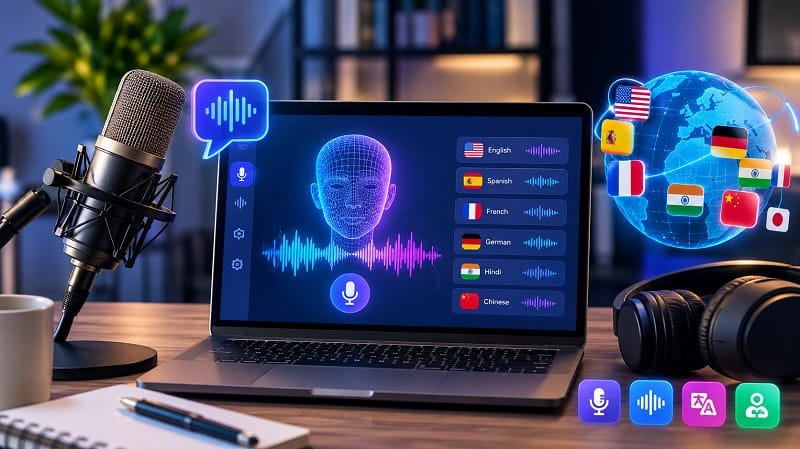

The best AI voice cloning software for multilingual branding can turn one approved brand voice into natural-sounding narration across multiple markets without requiring a new recording for every language. The strongest platforms now combine voice cloning, multilingual text-to-speech, dubbing, pronunciation controls, APIs, and brand-oriented workflows, making them useful for advertising, e-learning, product videos, podcasts, customer support, and social media.
For a global brand, however, language count alone is not enough. A convincing localized voice must preserve the speaker’s identity while handling accents, names, technical terminology, pacing, and emotional delivery appropriately. Platforms such as ElevenLabs, Resemble AI, HeyGen, Synthesia, and Rask AI have built multilingual cloning directly into production workflows, while tools such as Descript and Kapwing are stronger when voice generation is part of a broader editing process.
The right choice depends on whether the priority is audio quality, multilingual reach, video localization, API integration, enterprise governance, or production cost. Pricing and features below were checked against official provider information available on August 14, 2026; plans can change, so commercial buyers should verify the final price and licensing terms before purchase.
Best AI Voice Cloning Software for Multilingual Branding
ElevenLabs
ElevenLabs is the strongest all-around choice for multilingual voice cloning. Its platform supports voice creation in 32 languages, while its multilingual v2 models support 29 languages and its Flash v2.5 model supports 32. Instant Voice Cloning can be created from a short recording, while Professional Voice Cloning is available from the Creator plan upward for higher-fidelity production work.
The platform is particularly well suited to brands that need one recognizable voice across advertising, podcasts, product narration, localization, and developer-driven applications. Its API also supports multilingual text-to-speech, with official API pricing listed at $0.10 per 1,000 characters for Multilingual v2 and v3 models. Pricing for consumer plans begins at $5 per month for Starter, with Creator listed at $22 per month and Pro at $99 per month in current provider and market documentation. For a brand that values natural prosody and broad language coverage, the main advantage is consistency; the drawback is that high-volume enterprise usage can become substantially more expensive than entry-level plans.
- Multilingual voice cloning
- Instant and Professional Voice Cloning
- Multilingual text-to-speech API
- Voice design and voice library
- Dubbing and localization workflows
Buy from the official ElevenLabs website.
Resemble AI
Resemble AI is particularly attractive for companies that treat synthetic voice as part of a software product rather than simply a content-production tool. Its current voice-creation technology can clone a voice from as little as 10 seconds of audio and generate speech across 23 languages while retaining vocal character and accent. The platform also provides pronunciation controls, real-time streaming, and deployment options designed for developers and enterprise teams.
Its security and provenance features distinguish it from many creator-focused competitors. Resemble’s Chatterbox Multilingual model includes watermarking and supports more than 20 languages, while the company’s enterprise offering adds capabilities such as custom fine-tuning, on-premises deployment, service-level agreements, and advanced watermarking and detection. Resemble’s published creator pricing has included a $19 monthly Creator plan after introductory pricing, although usage-based and enterprise options can vary. The trade-off is that its developer-oriented feature set can feel more complex than a simple voiceover studio.
- Zero-shot multilingual voice cloning
- Real-time voice generation
- Custom pronunciation controls
- Watermarking and detection technology
- On-premises and enterprise deployment
Buy from the official Resemble AI website.
Murf AI
Murf AI is a strong fit for marketing departments, training teams, agencies, and businesses that need polished voiceovers rather than a developer-first voice infrastructure. Its current voice generator offers more than 200 voices across 35-plus languages and 10-plus accents, with emphasis on natural intonation, pronunciation, and professional narration.
The platform works particularly well when multilingual branding involves presentations, advertisements, explainers, courses, or corporate communications. Murf’s strength is the studio experience: teams can create and refine narration inside a broader production environment instead of building an audio pipeline around an API. Custom voice cloning is positioned for larger-scale business use, so smaller companies looking specifically for inexpensive personal voice cloning may find other platforms more accessible. Pricing commonly starts around $19 per month for creator-oriented plans when billed annually, with higher business and enterprise tiers.
- 200-plus AI voices
- 35-plus supported languages
- Professional voiceover studio
- Pronunciation and emphasis controls
- Enterprise custom voice options
Buy from the official Murf AI website.
Speechify Studio
Speechify Studio combines voice cloning with voiceover production, dubbing, and audio editing. Its current Studio Starter plan costs $19 per month and includes voice cloning, commercial usage rights, 7,200 Studio credits, and access to more than 1,000 voices. Studio Creator is listed at $49 per month.
Speechify is especially useful for brands producing large amounts of narrated content. Its Studio platform supports multilingual voiceover and dubbing, with provider documentation listing languages including English, Spanish, French, German, Portuguese, Italian, Chinese, Hindi, Japanese, Korean, Polish, Turkish, Swedish, Russian, Danish, and Dutch. The credit system also makes production consumption easier to track because new speech generation consumes credits based on the type and duration of the generation. The limitation is that Speechify’s broader ecosystem is heavily oriented toward voiceover and audio production rather than the deep developer controls offered by Resemble AI or ElevenLabs.
- Voice cloning
- Voiceover and dubbing studio
- 1,000-plus voice library
- Commercial usage rights on paid Studio plans
- Multilingual audio production
Buy from the official Speechify website.
Descript
Descript takes a different approach by placing AI voice cloning inside a text-based audio and video editor. That makes it particularly useful for podcasters, video marketers, publishers, and social media teams that need to correct or replace spoken sections without returning to the recording booth. The current pricing page lists Creator at $12 per editor per month when billed annually and Pro at $24 per editor per month annually, with unlimited Overdub AI voice cloning included in Pro.
The major strength is workflow efficiency. A producer can edit a transcript and use a cloned voice to regenerate a section instead of rebuilding an entire recording. Descript is therefore excellent for branded English-language production and editing, but it is less compelling than dedicated multilingual cloning platforms when the central requirement is producing the same branded voice across a large number of languages.
- AI voice cloning with Overdub
- Text-based audio editing
- Video editing
- Automatic transcription
- Podcast and social content workflows
Buy from the official Descript website.
HeyGen
HeyGen is one of the better choices when multilingual voice cloning needs to be paired with video rather than delivered as an audio file alone. Its Creator plan is listed at $29 per month and includes voice cloning and access to 175-plus languages and dialects. Pro costs $49 per month, while Business is listed at $149 per month.
The platform’s key advantage is the connection between voice, digital avatars, translation, and video production. HeyGen says its voice cloning can carry a cloned voice across 175-plus languages and dialects, allowing brands to localize training, marketing, sales, and communications without recording a separate voice track for every market. It is a particularly strong fit for multinational companies producing presenter-led videos, although companies that only need audio may pay for video capabilities they do not actually use.
- Voice cloning
- 175-plus languages and dialects
- AI avatars and digital twins
- Video translation and dubbing
- Enterprise governance controls
Buy from the official HeyGen website.
Synthesia
Synthesia is built around AI video creation and is particularly well suited to enterprise training, internal communications, sales enablement, and localized corporate content. Its voice-cloning technology supports multilingual production, while its video platform offers 160-plus languages and voices and one-click translation workflows.
The company’s voice-cloning documentation describes custom voice creation across dozens of languages, while its AI dubbing product supports more than 140 languages. Synthesia makes the most sense when a branded voice is only one component of a complete localized video workflow. Businesses can pair the cloned voice with a custom avatar and translated presentation rather than managing audio, video, captions, and localization in separate applications. Its limitation is the same strength: audio-only users may find dedicated voice platforms more economical.
- Multilingual voice cloning
- AI presenter avatars
- 140-plus language dubbing
- One-click video translation
- Enterprise security and administration
Buy from the official Synthesia website.
Rask AI
Rask AI focuses heavily on video localization, making it useful for brands that already have finished video content and want to distribute it internationally. Its current pricing page lists a free trial with three minutes and a Creator plan at $60 per month, while annual billing can reduce the effective Creator price to $33 per month under the currently advertised offer.
Rask’s voice cloning supports 32 languages, while its broader translation system supports more than 135 languages. The platform is designed around video translation, voice cloning, editing, subtitles, and dubbing rather than pure text-to-speech. That makes it a strong option for YouTube channels, training libraries, marketing campaigns, and publishers that need to turn one video into multiple localized versions.
- Voice cloning in 32 languages
- 135-plus translation languages
- Video dubbing
- Built-in editing
- Localization workflow
Buy from the official Rask AI website.
Maestra
Maestra combines transcription, translation, subtitles, voiceover, and voice cloning in one localization platform. Its current Voiceover Basic plan costs $39 per month and provides 120 minutes of voiceover into another language. Premium costs $79 per month and includes 300 minutes of multilingual voiceover or 100 minutes of professional voices and voice cloning. Business costs $159 per month, with higher usage allowances.
Maestra is particularly appealing to localization teams that need translation infrastructure alongside synthetic speech. Its platform supports transcription in more than 125 languages and provides translation, custom dictionaries, API access, and team-oriented workflows at higher tiers. The platform is less focused on creating a single celebrity-style branded voice than some dedicated cloning systems, but it can be more practical for companies managing large multilingual media libraries.
- 125-plus transcription languages
- Multilingual voiceover
- Voice cloning on higher tiers
- Translation and subtitle tools
- API and team workflows
Buy from the official Maestra website.
Kapwing
Kapwing brings voice cloning into a browser-based video editing environment. Its Business plan currently costs $50 per member per month when billed annually, or $64 monthly, and includes custom voice clones, lip-sync video capabilities, and 4,000 monthly credits.
The platform says its custom voice cloning is available to Business customers and can be used inside the Brand Kit for multilingual dubbing workflows. Kapwing also supports AI dubbing and subtitle translation, which makes it useful for social media teams that need to create localized video versions without moving between several applications. The downside is that its voice cloning is primarily part of a larger video-production stack rather than a dedicated voice platform.
- Custom voice clones
- AI dubbing
- Lip-sync video
- Brand Kit
- Browser-based video editing
Buy from the official Kapwing website.
WellSaid
WellSaid is aimed at professional voiceover production for businesses rather than unrestricted personal voice cloning. Its current Starter plan costs $10 per month when billed annually and includes 240 downloaded minutes per year, unlimited generation, English voices, and commercial rights. Pro costs $33 per month when billed annually.
The service emphasizes curated voices, pronunciation, tone, pitch, and emotional control, making it a sensible choice for organizations that want predictable professional narration. WellSaid is better considered a controlled corporate voice platform than a multilingual personal-clone specialist. Companies seeking a single speaker’s cloned identity across many languages should therefore examine ElevenLabs, Resemble AI, HeyGen, or Synthesia first.
- Professional AI voiceover
- Commercial usage rights
- Voice and tone controls
- Team and enterprise plans
- API availability
Buy from the official WellSaid website.
AI Voice Cloning Pricing for Multilingual Brands
Pricing varies considerably because these platforms measure usage differently. Some charge by characters, some by generated minutes, some by credits, and others combine subscriptions with usage-based API billing. A $20 monthly subscription therefore cannot be compared directly with a service charging a few cents per thousand characters without first estimating the amount of speech the brand actually produces.
For individual creators, entry-level paid plans generally fall around the $5-to-$30 monthly range. ElevenLabs starts at $5 for its Starter plan, Descript lists Creator at $12 annually billed, Speechify Studio starts at $19, and HeyGen Creator costs $29. These plans can be enough for testing a brand voice, producing short campaigns, or localizing a modest content library.
Professional teams should focus on the unit economics of finished output rather than subscription price alone. Rask AI, for example, prices its Creator plan around monthly video minutes, while Maestra offers voiceover minutes and Resemble AI supports usage-oriented production. High-volume brands should model the expected number of campaigns, languages, revisions, and final minutes before committing to an annual contract.
How to Choose Multilingual Voice Cloning Software
Start with the exact language markets that matter. A platform advertising 100 or more languages may not provide voice cloning in all of those languages. ElevenLabs, Resemble AI, Rask AI, and Synthesia publish specific language support for their cloning systems, which makes them easier to evaluate against a real localization plan.
Next, evaluate voice consistency rather than the number of voices in the library. A global brand normally needs one recognizable identity, not hundreds of unrelated synthetic speakers. Listen for pronunciation of product names, acronyms, place names, numbers, and technical terminology in every target language.
Workflow integration is another major factor. A marketing team producing finished videos may benefit more from HeyGen, Synthesia, Rask AI, or Kapwing than from an API-first voice engine. A software company building an automated voice assistant should place much greater weight on API latency, SDKs, streaming, usage controls, security, and deployment options.
Commercial rights also deserve close attention. A free voice sample can be useful for testing, but brands need clear permission to publish generated audio in advertising, paid media, training, product experiences, and commercial video. Speechify Studio explicitly includes commercial usage rights in paid Studio plans, while WellSaid’s Starter plan includes commercial rights.
Finally, examine consent and provenance controls before cloning a real person’s voice. Consumer Reports found that several major voice-cloning services tested in its research relied on user attestations, while Descript and Resemble AI used additional consent-related safeguards. A serious brand should maintain written authorization from the speaker, document ownership of the recordings, and establish an internal approval process before deployment.
Current AI Voice Cloning Prices and Deals
Current pricing favors experimentation. ElevenLabs offers a very low-cost entry point for creators, while Descript, Speechify, HeyGen, and WellSaid provide comparatively accessible subscriptions for teams with broader production needs. Annual billing can reduce effective monthly costs, but the savings should be weighed against expected usage and cancellation flexibility.
Several providers are also moving toward usage-based models. Resemble AI supports production workflows that can scale according to actual generation, while ElevenLabs publishes separate API rates for its multilingual models. This structure can be attractive for software companies that generate speech intermittently because the business is not necessarily paying for a large unused monthly allowance.
Video localization platforms can be more expensive at first glance because the subscription includes translation, dubbing, editing, avatars, or lip synchronization. For a brand that already pays for those services separately, however, the combined workflow can be cheaper than assembling several specialized tools.
Pro Tips for Multilingual AI Voice Branding
Record the source voice under controlled conditions. A clean recording with consistent microphone placement, minimal background noise, and natural pacing gives the cloning model better material to work with. More audio is not automatically better if the recording contains room noise, inconsistent volume, or exaggerated delivery.
Build a pronunciation dictionary before generating campaign audio. Product names, company names, abbreviations, medicines, technical terms, and geographic names often require special handling. Resemble AI, for example, provides custom pronunciation controls that can apply approved pronunciation across voices and API calls.
Use native-language review for every important market. A voice can sound technically fluent while still using an unnatural regional pronunciation or inappropriate emphasis. Human review is especially important for advertising copy, legal statements, product claims, and culturally sensitive campaigns.
Keep one master voice identity but allow market-specific delivery. A German advertisement may require a different pace and emotional style from an English advertisement even when both use the same cloned speaker. Consistency should mean recognizable identity, not identical performance.
Store the original consent documentation with the voice asset. Treat a cloned voice like a controlled brand asset, with clear ownership, approved users, permitted applications, and a process for revoking access if the relationship with the speaker changes.
Test short samples before generating long-form content. A 20-second sample can reveal incorrect pronunciation, unnatural pauses, or language-specific problems before a team spends credits producing a 30-minute course or a complete product library.
For customer-facing applications, measure more than realism. Latency, reliability, pronunciation accuracy, interruption handling, privacy, and operational cost can matter more than whether a demo sounds impressive through headphones.
Frequently Asked Questions About AI Voice Cloning
What is the best AI voice cloning software for multiple languages?
ElevenLabs is one of the strongest overall choices because it combines high-quality cloning with multilingual speech, dubbing, API access, and multiple voice-creation options. Resemble AI is particularly compelling for developers and enterprise deployments, while HeyGen and Synthesia are stronger when voice cloning needs to be combined with localized video.
Can one cloned voice speak different languages?
Yes. Modern multilingual voice-cloning systems can generate the same speaker identity in multiple languages without requiring a separate recording for every language. The exact language coverage varies by platform, model, and subscription, so the provider’s cloning-language list should be checked rather than relying on its overall language count.
Is AI voice cloning legal for commercial branding?
Commercial use can be lawful when the person whose voice is cloned has provided appropriate authorization and the platform’s licensing terms permit the intended use. Legal requirements differ by jurisdiction and use case, so brands should obtain documented consent and review applicable publicity, privacy, intellectual-property, and synthetic-media rules before publishing cloned voice content.
How much does multilingual AI voice cloning cost?
Entry-level subscriptions can cost as little as $5 per month, while professional platforms commonly range from roughly $19 to $79 per month and enterprise deployments can cost considerably more. Usage-based API billing may be more economical for applications with variable demand, while video localization platforms often charge according to minutes, credits, or generated content.
Which AI voice cloning tool is best for YouTube?
ElevenLabs is a strong option when the main requirement is realistic multilingual narration. Rask AI, HeyGen, Synthesia, and Kapwing become more attractive when the workflow includes video translation, dubbing, avatars, subtitles, or lip synchronization.
Which platform is best for enterprise voice cloning?
Resemble AI is particularly strong for enterprises that need security, APIs, custom pronunciation, deployment flexibility, and provenance controls. HeyGen and Synthesia are also well suited to enterprise localization when the cloned voice is part of a broader video-production workflow.
Can AI voice cloning replace professional voice actors?
It can reduce the need for repeated recording in many controlled production scenarios, especially when a brand needs dozens of language versions or frequent script corrections. It does not eliminate the value of professional voice actors for original performances, high-stakes advertising, character work, or situations where nuanced human direction is central to the creative result.
What audio quality is needed for voice cloning?
Clean, intelligible recordings with minimal background noise generally produce better results than heavily processed or noisy samples. A controlled microphone setup, consistent speaking distance, natural delivery, and sufficient speech material provide a stronger foundation for the model than a short recording captured in a noisy environment.
Conclusion: Choosing the Right Multilingual Voice Platform
The best AI voice cloning software for multilingual branding depends on the production problem being solved. ElevenLabs is the strongest general-purpose choice for realistic multilingual voice generation, while Resemble AI stands out for developer and enterprise voice infrastructure. HeyGen, Synthesia, and Rask AI are better suited to brands where voice cloning is part of a broader video-localization strategy. Speechify, Descript, Murf, Maestra, Kapwing, and WellSaid each occupy useful niches around audio production, editing, corporate narration, translation, or collaborative workflows.
The most effective buying decision starts with the brand’s actual language list, monthly audio volume, distribution channels, required integrations, commercial licensing, and consent requirements. A convincing demo is only the first test. For long-term multilingual branding, the winning platform is the one that preserves a recognizable voice identity while delivering reliable pronunciation, natural delivery, manageable costs, and appropriate controls across every market.
