
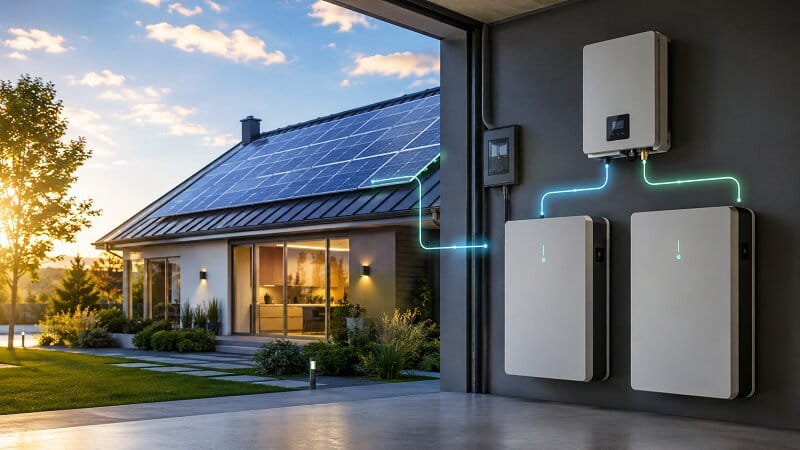

Home energy storage is no longer just a luxury for the eco-conscious; it has become a mechanical necessity for modern households facing rising utility costs and grid instability. The current landscape is defined by a shift toward Lithium Iron Phosphate (LFP) chemistry, which offers superior safety and longevity compared to older technologies.
Whether you are looking for whole-home backup or a way to participate in Virtual Power Plants (VPPs), selecting the right system requires balancing power output, capacity, and modularity. This guide explores the premier solutions currently dominating the market.
1. Top Energy Storage Systems: Comparative Analysis
The leading systems available today cater to different household priorities, from all-in-one simplicity to extreme modularity.
| System | Capacity | Power Output | Key Advantage |
| Tesla Powerwall 3 | 13.5 kWh | 11.5 kW | Best Integrated Hybrid Inverter |
| Enphase IQ Battery 5P | 5.0 kWh | 3.84 kW | 15-Year Warranty & Modularity |
| FranklinWH aPower 2 | 15.0 kWh | 10.0 kW | Robust Whole-Home Backup |
| Canadian Solar EP Cube | 9.9 – 19.9 kWh | 7.6 kW | High Value-to-Performance Ratio |
| Sigenstor (Sigenergy) | 5.0 – 48.0 kWh | Up to 25 kW | Integrated EV DC Fast Charging |
2. Tesla Powerwall 3: The Integrated Powerhouse
The Tesla Powerwall 3 has redefined the market by functioning as a true hybrid battery. Unlike previous versions that required separate equipment, this unit features a built-in solar inverter capable of handling high DC input from your panels.
-
High Surge Capability: With 11.5 kW of continuous power and massive surge capacity, a single unit is often enough to start heavy appliances like central air conditioners or well pumps.
-
LFP Chemistry: By utilizing Lithium Iron Phosphate, the system ensures high thermal stability and a longer cycle life, effectively removing cobalt from the supply chain.
-
Streamlined Installation: The integrated design reduces the number of boxes on your wall, lowering labor costs and simplifying the overall electrical footprint.
3. Enphase IQ Battery 5P: The Reliability Standard
For those who prioritize redundancy and long-term security, the Enphase IQ Battery 5P offers a distributed architecture. Each 5 kWh module contains multiple microinverters, ensuring that a single component failure doesn’t take the entire system offline.
-
Extended Longevity: Enphase provides a 15-year limited warranty, reflecting high confidence in the system’s durability.
-
Granular Scaling: You can start with a single 5 kWh unit for essential circuits and add more modules as your energy needs grow.
-
Blackstart Technology: This allows the system to jumpstart your solar array even after a total battery drain during an extended outage, ensuring you can recharge the next morning.
4. FranklinWH aPower 2: Premium Energy Management
The FranklinWH aPower 2 is a high-capacity solution designed for large homes. It centers around the aGate, an intelligent controller that orchestrates power between the grid, solar, battery, and even standby generators.
-
Massive Storage: At 15 kWh per unit, it provides one of the highest storage densities in a single enclosure.
-
Generator Integration: It is one of the few systems that can seamlessly manage a traditional gas or propane generator alongside solar storage, providing a triple layer of energy security.
-
LFP Safety: Like other premier systems, it utilizes LFP cells for maximum safety and a 100% depth of discharge capability.
5. Sigenstor: The Future-Ready 5-in-1 System
A newcomer that has rapidly gained traction is the Sigenstor (Sigenergy). It is marketed as an integrated 5-in-1 system that combines the battery, solar inverter, and an optional EV DC Fast Charger into a single stackable tower.
-
EV Optimization: By charging your electric vehicle directly from DC (solar or battery) to DC (car), it eliminates the energy losses associated with converting back to AC.
-
Rapid Switching: The system can transition to backup mode in less than 20 milliseconds, protecting sensitive electronics like desktop computers during a sudden grid failure.
-
AI-Driven Management: The software uses predictive algorithms to analyze weather and usage patterns, ensuring you have maximum storage before a storm or high-rate period.
6. Understanding Battery Chemistry: Why LFP Wins
The industry has largely moved away from NMC (Nickel Manganese Cobalt) in favor of LFP (Lithium Iron Phosphate) for home applications.
-
Safety: LFP is chemically stable and significantly more resistant to thermal runaway (fire risk).
-
Cycle Life: While NMC batteries typically last 2,000–3,000 cycles, LFP systems often exceed 6,000–8,000 cycles, translating to over 15 years of daily use.
-
Ethical Sourcing: LFP does not require cobalt or nickel, which are often associated with high environmental and ethical mining costs.
7. Maximizing Value: VPPs and Grid Services
Modern batteries are no longer passive storage units; they are active assets. Through Virtual Power Plant (VPP) programs, homeowners can earn significant credits by allowing the grid to “borrow” energy during peak demand events.
-
Earning Potential: In high-incentive regions like the Northeast and California, participants can earn between $500 and $1,500 annually in bill credits or direct payments.
-
Grid Support: By exporting power during heatwaves or peak hours, your home helps prevent local blackouts and reduces the need for fossil-fuel “peaker” plants.
-
Self-Consumption: Even without a VPP, batteries save money through Time-of-Use (TOU) Arbitrage, charging when rates are low and discharging when utility prices spike.
8. Selection Guide: Sizing Your System
To choose the right capacity, you must define your primary goal:
-
Critical Load Backup: (5–10 kWh) Keeps the fridge, lights, and internet running.
-
Partial Home Backup: (13.5–20 kWh) Adds support for small appliances and several rooms.
-
Whole-Home Independence: (30+ kWh) Provides enough power for central HVAC systems and heavy electric appliances during multi-day outages.
Frequently Asked Questions
Can I add a battery to my existing solar system? Yes. Systems like the Enphase 5P and FranklinWH are “AC-coupled,” meaning they can be retrofitted to any existing solar installation regardless of the brand of your current inverter.
How long will a 10 kWh battery last during an outage? For essential loads (fridge, LED lights, WiFi), a 10 kWh battery can typically last 18–24 hours. If you run a central air conditioner, it may only last 2–4 hours.
Is it worth getting a battery without solar? In regions with high Time-of-Use rates, a battery can save money by charging from the grid at night and powering the home during expensive afternoon hours. It also provides peace of mind as a backup during outages.
Conclusion
The transition to a decentralized energy grid is well underway, and home storage is the foundational technology making it possible. From the high-output Tesla Powerwall 3 to the innovative Sigenstor with its EV integration, the choices available today allow for a highly customized energy strategy. By focusing on LFP chemistry and participating in grid service programs, homeowners can secure energy independence while achieving a faster return on investment.