
Fierce Deity Link Unmasked: Complete Guide to Majora’s Mask’s Ultimate Power, Lore & Legacy

One of the most legendary and debated transformations in video game history is the Fierce Deity, a form Link can assume in The Legend of Zelda: Majora’s Mask. Over two decades since its introduction, this formidable warrior continues to captivate players with its immense power, enigmatic origins, and profound thematic weight. It is not merely a power-up but a narrative and philosophical keystone in a game celebrated for its depth and darkness.
This article delves into the complete story of the Fierce Deity, exploring the intricate steps to unlock its power, analyzing its devastating combat abilities, and deciphering the deep lore and symbolism that makes it a subject of enduring fascination. We will examine how this ultimate transformation redefines gameplay and what its enduring legacy means for the Zelda franchise and gaming as a whole.
The Enigmatic Origins and Lore of the Fierce Deity
The Fierce Deity is shrouded in mystery. Unlike other items in Link’s inventory, its origins are never explicitly detailed in Majora’s Mask. The game provides only fragments of lore, delivered through cryptic dialogue from the enigmatic “Happy Mask Salesman” and the unsettling moon children. This deliberate ambiguity has fueled countless fan theories and deep analyses for over twenty years, making the Fierce Deity one of gaming’s greatest lore puzzles.
The primary clue comes from the Happy Mask Salesman himself, who calls the Fierce Deity’s Mask “the embodiment of the fears and regrets of all the people of Termina.” This suggests the mask was not created from a singular being but was forged from collective negative energy. Another popular theory, supported by the mask’s Japanese name “Oni Link” and its visual design, posits that it represents an “evil” or wrathful deity. This interpretation aligns with the game’s themes of duality, suggesting Link must harness a power born of darkness to defeat a greater darkness.
Many theorists connect the Fierce Deity to the ancient hero spoken of in the Stone Tower Temple, a figure who once battled the giants. Others see it as a dark mirror to Majora itself—two god-like masks of immense power locked in a final, cataclysmic struggle. The most compelling evidence lies in the method of obtaining the mask: Link must collect the masks of every significant character he has helped. In this act, he is not just gathering trinkets but collecting their gratitude, their stories, and perhaps a piece of their spirit, channeling the collective hope of Termina into a single, focused weapon against despair.
The Path to Power: How to Obtain the Fierce Deity’s Mask
Acquiring the Fierce Deity’s Mask is the ultimate challenge in Majora’s Mask, requiring players to complete nearly every major task in the game. It is not found in a dungeon but earned through exhaustive compassion and effort. The process is a testament to the game’s core theme: that true power comes from helping others.
To earn the mask, Link must collect all twenty-four regular masks throughout Termina. This is a monumental task that involves:
- Completing the Four Main Dungeons: Solving the puzzles and defeating the bosses of Woodfall, Snowhead, Great Bay, and Stone Tower Temple to obtain the four key transformation masks.
- Exhausting Side Quests: Helping virtually every citizen of Clock Town and the surrounding regions. This includes reuniting Anju and Kafei, helping the Rosa Sisters, curing Pamela’s father, and bringing peace to countless troubled souls.
- Mastering Mini-Games: Excelling at challenges like the Archery Range, the Beaver Races, and the Goron Racetrack to win specific masks as prizes.
Once every mask is collected, players must confront the final boss, Majora. On the moon, in the field where the final battle awaits, the possessed Skull Kid will challenge Link to a “game.” If Link possesses all the masks, the moon children will appear and, one by one, ask to play. By offering them the correct masks in a “mask trading” sequence, Link is ultimately rewarded with the Fierce Deity’s Mask just before the climactic fight.
Unleashing Godhood: The Abilities of Fierce Deity Link
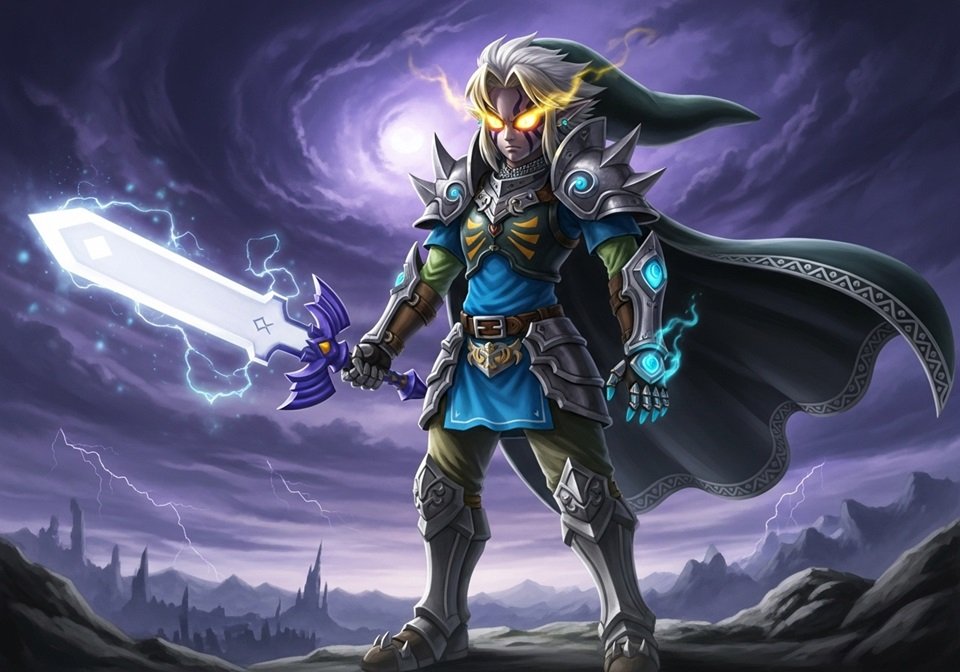
Transforming into the Fierce Deity is a dramatic and empowering moment. Link sheds his youthful form, growing taller and donning imposing white and red armor, his face painted with fierce war markings. The gameplay shift is immediate and total. This form is designed for one purpose: overwhelming, destructive combat.
The core abilities of Fierce Deity Link include:
- The Great Sword of the Fierce Deity: This massive, double-helix blade replaces Link’s regular sword. It has immense range and deals catastrophic damage, often defeating standard enemies in a single hit and staggering bosses with ease.
- Magical Energy Projectiles: By holding the attack button, Link charges and fires powerful pink energy beams from his sword. These projectiles cost magic but can snipe enemies from a distance and deal heavy damage, making them ideal for safe engagement.
- Enhanced Mobility and Defense: While not explicitly faster in movement, the Fierce Deity’s attacks are swift and fluid. More importantly, he possesses a high degree of super armor during many attacks, meaning he is not easily staggered or interrupted by enemy blows.
- No Transformation Limitations: Unlike the Deku, Goron, or Zora masks, which have situational weaknesses, the Fierce Deity has no environmental drawbacks. He can be used anywhere, albeit only in specific combat scenarios or boss rooms.
The transformation trivializes most combat encounters, which is its intended design. It serves as a reward for players who have mastered the game’s challenges, allowing them to experience the catharsis of absolute power in the final showdown.
Strategic Impact: The Fierce Deity in Gameplay and Boss Battles
The introduction of the Fierce Deity fundamentally alters the gameplay dynamics of Majora’s Mask. For most of the game, players must rely on strategy, resource management, and the unique utility of Link’s three transformation masks. The Fierce Deity subverts this, replacing nuance with raw, undiluted strength. This creates a fascinating strategic layer: the choice of when to use this ultimate power.
The mask can only be used in designated “boss rooms” and certain other combat scenarios, primarily against the formidable Iron Knuckle enemies. This restriction is crucial. It prevents the mask from breaking the game’s overall balance while making those specific encounters spectacular power fantasies. The most significant and intended use is, of course, the final battle against Majora.
Dominating the Final Confrontation
The battle against Majora is a multi-phase fight against a chaotic and powerful foe. Using the Fierce Deity’s Mask here recontextualizes the entire encounter:
- Phase 1 (Majora’s Incarnation): The Fierce Deity’s sword and projectiles make short work of this acrobatic phase, allowing players to aggressively pressure the boss without fear of reprisal.
- Phase 2 (Majora’s Wrath): This tentacled phase, which can be frustrating in normal combat, becomes manageable as the Fierce Deity’s energy beams can safely target its weak points from across the arena.
- Phase 3 (Majora’s Mask): The climactic duel against the mask itself becomes a dramatic exchange of powerful energy blasts, feeling less like a desperate struggle and more like an epic clash between rival deities.
While using the mask makes the fight easier, it does not rob it of its emotional or visual impact. Instead, it fulfills the narrative promise of Link harnessing the collective strength of Termina to face its doom. For players who have completed every side quest, it is the satisfying culmination of their journey.
Cultural Impact and Enduring Legacy
The Fierce Deity has transcended its role as a video game power-up to become a cultural icon within the gaming community. Its striking design and aura of mystery have cemented its place as one of the most recognizable and celebrated forms of Link.
This legacy is visible in several key areas:
- High-Value Collectibles: The character is a staple in high-end merchandise, from detailed Figma and Nendoroid action figures by Good Smile Company to premium statues from First 4 Figures, often commanding high prices from collectors.
- Crossover Appearances: The Fierce Deity has appeared in numerous other games, most notably as a powerful and visually distinct character in the Super Smash Bros. series, both as an Assist Trophy and as an alternate costume for Link, introducing the form to millions of players outside the Zelda fanbase.
- Inspiration for Mods and Fan Content: The design continues to inspire extensive fan art, cosplay, and video game mods that add the Fierce Deity’s armor and weapons into other titles like *The Elder Scrolls V: Skyrim* or *Dark Souls*.
Perhaps its most significant legacy is its narrative ambition. The Fierce Deity demonstrated that a transformation could be more than a gameplay mechanic; it could be a vessel for deep, unsettling lore and thematic resolution. It set a high bar for meaningful power-ups in gaming, proving that the most rewarding abilities are those earned through story and sacrifice, not simply found in a treasure chest.
Decoding the Symbolism: Power, Sacrifice, and Duality
The Fierce Deity is the philosophical heart of Majora’s Mask. It is the key to understanding the game’s exploration of maturity, trauma, and the cost of heroism. On the surface, it is a weapon to defeat a monster. On a deeper level, it is a complex symbol.
Most centrally, it represents the duality of power. To save Termina, Link must wield a mask described as being filled with “fears and regrets.” He must use a power that feels dangerous and ominous to achieve a heroic end. This reflects the game’s overarching theme that confronting darkness—both in the world and within oneself—is necessary for growth. The Fierce Deity is not a “good” power; it is a necessary one.
Furthermore, it symbolizes the burden of the hero. Obtaining the mask requires Link to absorb the struggles of every person he helps. He carries their stories into battle. The Fierce Deity, therefore, can be seen as the physical manifestation of that collective burden—immensely powerful, but also heavy with the weight of an entire world’s suffering. Its use in the final battle signifies Link fully accepting this responsibility.
Finally, it completes the game’s commentary on masks and identity. Throughout the game, masks allow Link to become someone else—a Deku, a Goron, a Zora—to solve problems. The Fierce Deity’s Mask is the ultimate extension of this: to become a god to solve the ultimate problem. It asks whether putting on a mask changes who you are inside and what part of yourself you sacrifice when you take on a role of such immense power.
Pro Tips for Mastering the Fierce Deity
While the Fierce Deity is straightforwardly powerful, using it effectively, especially in challenge runs or against optional bosses, can enhance the experience.
- Conserve Magic for Projectiles: Your magic meter is your most important resource. Use the sword for close-up foes, but switch to charged energy beams for flying enemies, distant attackers, or to safely damage a boss’s weak point. Always keep a Green Potion or Chateau Romani in your inventory for extended battles.
- Exploit Super Armor: Don’t be afraid to trade hits. The Fierce Deity can often power through enemy attacks without being flinched, allowing you to maintain offensive pressure. This is particularly useful against bosses like Twinmold.
- Use It on the Iron Knuckles: The Fierce Deity’s Mask can be used in the secret encounters with the Iron Knuckle enemies in the Stone Tower Temple. This turns these difficult, endurance-based fights into swift and satisfying victories.
- Experience the Battle Both Ways: For the full narrative impact, fight Majora once without the mask to experience the desperate, technical struggle. Then, on a subsequent cycle (using the Song of Time to reset), earn the mask and experience the climactic, godly showdown. The contrast is a core part of the game’s design.
Frequently Asked Questions
Can you use the Fierce Deity’s Mask outside of boss rooms?
No, with very few exceptions. The game restricts its use primarily to boss arenas and specific “hard” enemy encounters like the Iron Knuckles. You cannot explore the overworld of Termina as the Fierce Deity, a design choice that preserves the game’s balance and the specialness of the transformation.
Is the Fierce Deity the most powerful form of Link?
Within the context of Majora’s Mask and in terms of pure combat prowess, yes, absolutely. In the broader Zelda universe, power levels are harder to compare. However, forms like the Dark Link (as an opponent) or the full Triforce-wielding Hero of the Wild from *Breath of the Wild* and *Tears of the Kingdom* could be considered contenders for different reasons.
What is the “Fierce Deity Sword” in *Tears of the Kingdom*?
In *The Legend of Zelda: Tears of the Kingdom*, you can find and fuse a material called the “Fierce Deity Sword.” This is a nod and homage to the original mask. While powerful, it does not transform Link. It is a piece of legacy equipment that celebrates the enduring popularity of the Fierce Deity character.
Are there any downsides to using the Fierce Deity’s Mask?
From a gameplay perspective, the only downside is the consumption of magic when using energy beams. There is no narrative or permanent penalty. Some players feel using it makes the final boss too easy, but this is a subjective trade-off for the cathartic power fantasy it provides.
Conclusion
The Fierce Deity Link is far more than a simple cheat code or victory lap for dedicated players. It is the brilliant culmination of Majora’s Mask’s most defining traits: its intricate side quests, its melancholic tone, and its willingness to explore mature themes. The journey to obtain the mask is a microcosm of the entire game, requiring empathy, perseverance, and a connection to the world and its people. The transformation itself redefines combat, delivering an unmatched sense of power that feels earned rather than given.
Its lasting appeal lies in this perfect synergy of gameplay and narrative. The mystery of its origins invites endless speculation, its design remains iconic, and its symbolic weight—representing the burdensome, dualistic nature of true power—ensures it is discussed and analyzed decades later. The Fierce Deity is not just a mask Link wears; it is the embodiment of his ultimate trial in Termina, a testament to the idea that the greatest strength is often forged from the collective hope and struggle of others. It secures its place not only as a legendary piece of Zelda history but as one of the most thoughtfully designed and meaningful power-ups in all of video games.